Does your cat just sit there, looking at you, when you toss it a ball or dangle a string? You may be concerned that your cat needs the stimulation and activity of play. Learn why your cat seems indifferent to play and what you can do about it.
Cats naturally fall into a range of personalities and activity levels. All kittens play but their interest in high-energy games peaks at around ages 4 to 5 months, and decline thereafter. Once cats reach adulthood, they tend to fall into two major groups: There are the ankle-rubbers who continue to play and the lap-sitters who prefer less activity. There can be ways to encourage activity, which is healthy for both the body and brain. However, there can be other issues that influence cat behaviors, which can be evaluated using the H.I.S.S. test.
HISS Test
Health
Health certainly influences activity levels. Age-related issues such as arthritis can reduce interest in play. Any sort of health challenge that makes the cat feel poorly—intestinal worms, for example—might reduce the cat’s activity.
Instinct
Cat play mimics hunting. Movement triggers paw-patting and chasing behavior. Kittens indulge in self-play and can entertain themselves. They have great fun tossing their cat toys and chasing human feet, but adult cats need more direct stimulation. Cat toys typically are only as good as the human on the other end of the toy.
Stress
Any kind of stress often brought about by a sudden change, can impact a cat’s activity level. Cats that feel overwhelmed by stress won’t want to play.
Symptoms
Changes in your cat's usual behavior can be a sign of a health condition. If your cat usually likes to play but suddenly is inactive or lethargic, it is worth talking to your veterinarian. A check-up might reveal a urinary tract infection or another issue that can be cleared up with treatment. If your cat is in good health, then you can look for ways to stimulate play more effectively.
Encouraging Play
An adult cat has outgrown the frantic play-activity of kittenhood. The cat may well have the personality of a lap-sitter, and not be inclined to play on its own. Perhaps the cat actually enjoys her “kitty TV” watching you pretend to be a cat and play the games for her. But you may simply not yet found the perfect toy for your kitty.
You may have tried catnip toys, but be aware that not all cats react to catnip. One-third of cats couldn't care less. Fresh catnip might convert a formerly-indifferent cat as it is much more potent. Visit a pet product store and purchase some growing catnip. Crush a leaf and see if your cat reacts better to the real thing. Catnip comes in a variety of potencies and can become old and stale very quickly. If you can get a bag full of very potent catnip, store some of the toys inside the bag to give them a lift.
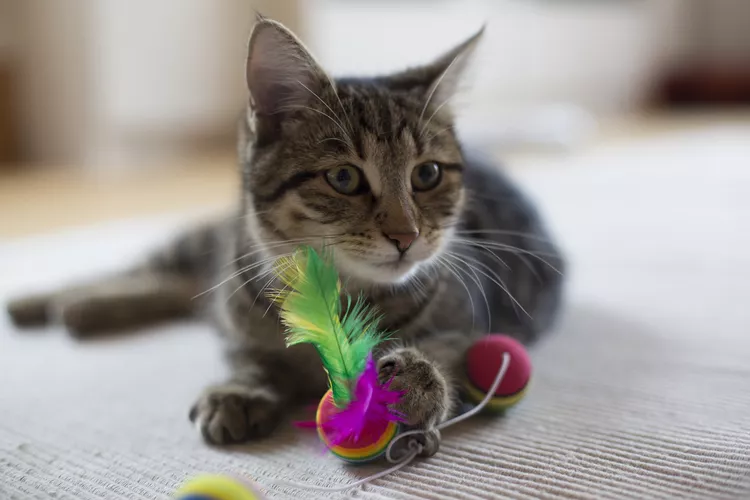
Toys need to move in an interesting way to garner your cat’s attention. Here are some things to try. Visit a pet product store—or even a hobby shop—and get a package of pheasant feathers. Cats rarely can resist them. The feather can be “snaked” along the floor for the cat to chase, or even held overhead for the cat to grapple. Playing a game with a “disappearing” feather really revs up some cats. Use an old shirt or pillow, and thread the long feather or a piece of yarn, underneath and slowly pull it so it “hides” right in front of the cat’s eyes. The cat can go nuts trying to grab it before the feather disappears.
Fishing pole lure toys really tickle the fancy of many cats. Forget the boring yarn, go for “Da Bird” toy with a fluttering feather on the end of the line that flies through the air. Cat product stores feature these lure toys, as well as feather wands called “cat teases” in a variety of styles. Some have bells, or shiny mylar, rattles and more that keep cats intrigued. Or you can try other cheap thrills with homemade toys.
New