
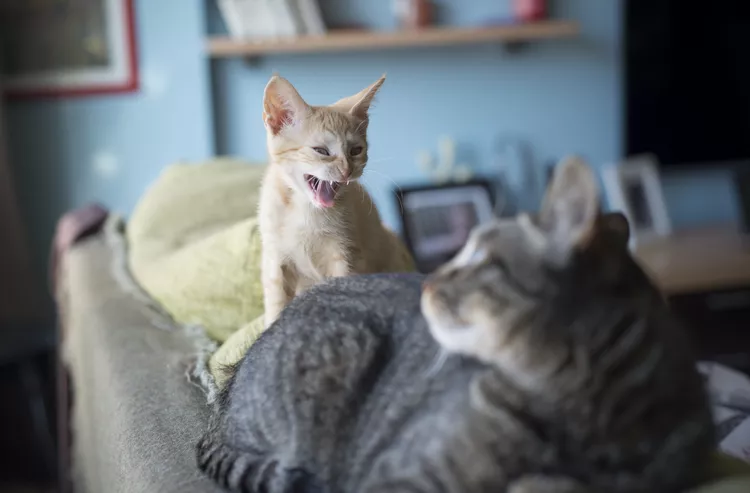
While it can be upsetting and frustrating, fighting between cats that live in the same household is a problem that in many cases can be prevented and resolved with the help of a cat behavior professional and veterinarian. Cat behavior is complex and there are a variety of reasons why aggression can occur.
Why Do Household Cats Get Aggressive?
Aggression is not a diagnosis; it is part of normal feline behavior and is strongly influenced by early social history and exposure to humans and other animals, gender, social context, handling, personality, and many other variables. Aggression between cohabitating cats can come in several forms with different causes. Fear, anxiety, medical issues, the inappropriate introduction of a new cat, and lack of resources all can contribute to inter-cat aggression within a household.
Lack of Socialization
Socialization is the process of preparing a cat to enjoy interactions and be comfortable with other animals, people, places and activities. Ideally, socialization should begin during the "sensitive period" which is between 2 and 7 weeks of age for kittens.
Many cats do not receive adequate socialization and due to this, problems are more likely to arise when one or more adults that have not been socialized to their own species are involved. Because these cats lack appropriate experiences, they do not understand normal feline communication and etiquette and are likely to have intense and inappropriate responses to the sight of another cat. They may run away and hide in fear, or they may attack in an attempt to drive the other cat away from their personal space.
During adequate socialization, the animal should develop appropriate social behavior towards their own species and those others with which they have been appropriately socialized. This will positively influence social behavior expressed later in life.
Introducing a New Cat
Properly introducing your new cat with your existing cats is essential, as introductions often lay the groundwork for their relationship. If your current cat has lived with other cats and was always friendly it can be very tempting to just let your new cat out in the same space as your current cat. You may assume they will just work it out; however, cats don’t always hit it off the right way and a negative initial meeting can set a poor foundation for their relationship.
Cat-to-cat introductions should be done slowly, and with the needs of each cat kept in mind. It is difficult to resist the urge to have the cats meet immediately so they can begin a wonderful friendship; however, if you let your new cat loose in the home a number of things can happen with less than stellar consequences.
Your existing cat may feel that their territory has been invaded if the newcomer is just let loose to explore. This could lead to your established cat feeling unsafe in their home and in turn that leads to behavior changes or it could be aggressive (offensive) towards the new cat. That does not help either of them!
From the new cat’s perspective, it is unsure of where it is. Every scent and sound is unfamiliar and a possible threat lurks around every corner. If you have adopted your new cat, it has likely experienced a controlled number of sounds and smells. It may also be used to living in a small space and while you want it to experience ‘freedom’, rushing it can leave it feeling very overwhelmed and stressed.
Competition for Resources
In multi-cat households, it is not uncommon for one or more cats to prevent access to important resources, such as food, water, and litter boxes. It is important to provide multiple and separated key environmental resources which include litter boxes, water, food, hiding spaces, places to perch, resting/sleeping areas, play areas, scratching areas, and toys. This helps to decrease social tension and competition, decreases territorial motivations, decreases stress and fear, and provides choices that all help to prevent aggression between cats.
The last thing cats want to do is fight. Instead, cats prefer to flee or avoid each other, as fighting can result in an injury. But if these options are not available, aggression is the last option. In multi-cat households, the cats are often not related, yet have to share their resources and have limited opportunity to hide or avoid situations of potential conflict.
Medical Issues
If you notice your cat has sudden changes in their behavior towards another cat in the home, your cat should be examined and have diagnostics to rule out underlying medical issues. Cats in pain can also uncharacteristically have episodes of aggression. A cat may begin to growl or hiss when other pets in the household approach them and have overall increased irritability. Other medical conditions such as hyperthyroidism, dental disease, osteoarthritis, and cognitive dysfunction can also cause increased irritability and aggression between cats.
Lack of Predatory Outlets
Cats have natural behaviors and needs, and they must have opportunities to express those behaviors. It’s important to provide your cat with predatory outlets which include a variety of toys, scheduled playtimes with cats separately once to twice daily, and puzzle food toys.
How to Treat Aggression Between Cats
Aggression refers to a wide variety of complex behaviors that occur for different reasons under various circumstances. Early intervention is best—contact your veterinarian and credentialed cat behavior professional to help as soon as you notice tension and/or aggression between cats.
- Identify any triggers that upset your cats (e.g. visualization of outdoor cats, loud noises) and alter the environment so that they are minimized/removed.
- Create an enriched feline environment that allows for natural coping .strategies. This includes multiple elevated single cat-sized resting perches throughout the environment, multiple litter boxes (the number of litter boxes should equal the number of cats plus one) in different locations throughout the home, multiple feeding and watering stations, multiple scratching posts/pad, etc.
- Make sure cats have plenty of appropriate outlets for play and enrichment.
- Keep cats separated when not supervised or if aggression is mild to severe, or keep them separated at all times to avoid furthering negative associations with each other.
- Gradually reintroduce the cats using counterconditioning and desensitization and watching closely for signs of stress and anxiety.
- Learn and monitor body language and at the first sight of aggression, stalking, or bullying, you should positively redirect the aggressor cat with a toy or treat away from the other cat.
- Avoid punishment. This includes yelling, spraying with water, loud noises (shaking cans of pennies, clapping) hitting, etc. Punishment can teach the cat to dislike the other cat more by associating the punishment with the other cat and can cause escalated fear and anxiety and break the human-animal bond.