
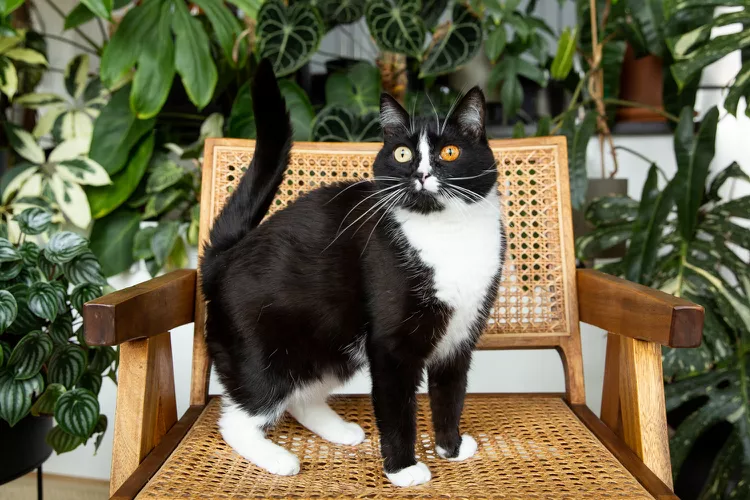
Tuxedo cats are best known for their bi-colored coats that look like tiny tuxedos. Although many tuxedo cats are black and white, these gorgeous kitties' coats can range in various colors like gray, silver, orange, and even tortoiseshell with patches of white. But there's a lot more to tuxedo cats than their good looks.
Want more? Check out these fascinating facts about nature's most dapper kitties.
Watch Now: 8 Surprising Facts About Tuxedo Cats
- 01 of 06
Tuxedo Cats Are Actually Piebald
Nope, tuxedo cats aren't a particular breed. Rather, they get their name from the distinct, bi-colored (also called piebald) markings on their coats that resemble tuxedos.
Like we said, tuxedo cats don't have to be black and white. And because they can be a variety of breeds, like Maine Coon, Turkish Angora, American shorthair, or British shorthair, their coats can be short, shaggy, long, or silky.
So, what causes their bi-colored coats? Read on for a little science lesson.
- 02 of 06
Their Coat Patterns Are Not Inherited
Like calico and tortoiseshell cats, tuxedo cats get their dapper duds—err, coat patterns during development. But it's not about genetics.
It was long believed that their patterns were the result of "slow" or "sluggish" pigment cells that couldn't reach all parts of the kitty embryo before it was fully formed, leaving white patches in the areas that the pigment cells missed.
A more recent theory, now suggests that pigment cells move and multiply randomly during the development of the embryo and they don't follow any particular genetic instructions for pattern.
In either case, the result is a random pattern and distribution of their colors and markings, so no two tuxedo cats will have the exact same pattern, even if they are cloned.
Although calico, tortoiseshell, and tuxedo cats do share some similarities in the formations of their markings, there's one major difference: most calico and tortoiseshell cats are female (thanks to a genetic link between orange and black coat colors and gender), but when it comes to tuxedo cats, the number of males and females are equal.
- 03 of 06
Tuxedo Cats Have a Place in History
Believe it or not, there are lots of tuxedo cats with some serious historical cred:
- William Shakespeare, Beethoven, and Sir Isaac Newton all had pet tuxedo cats. Who knows the level of artistic and scientific advancement these kitties inspired?
- Famous cats in pop culture, including Sylvester from Looney Tunes, the Cat in the Hat (the famed character from Dr. Seuss), and Mr. Mistoffelees from the Broadway show Cats are all tuxies.
- In 2012, a tuxedo cat named Tuxedo Stan from Halifax, Canada, ran for mayor of his fair city. Although Tuxedo Stan didn't take office, he still made history in both the cat and the human world.
- 04 of 06
The Richest Cat in the World Is a Tuxedo Cat
In 1998, a tuxedo cat named Sparky inherited a whopping 6.3 million dollars when his owner passed away, making him far richer than any other cat—and most human beings.
Continue to 5 of 6 below - 05 of 06
Tuxedo Cats Have Gone Where No Kitty Has Gone Before
With their good lucks and feline charms, it's no wonder that tuxedo cats have gone to many, many places no other kitty has gone before:
- Only one cat has ever made it to the top of Mount Everest and—you guessed it—he was a tuxedo cat. His human carried him, of course, but it's still pretty impressive, right?
- A tuxedo cat named Simon went to war during World War II and ended up receiving a medal for his services. How did he help the Allies? By protecting British food supplies from pests and mice.
- Yep, a tuxedo cat even made it into the White House. President Bill Clinton had a pet Tuxie during his service as President of the United States.
- 06 of 06
Tuxedo Cats Are Subject to Several Myths
Yes, Tuxies are awesome cats. Perhaps this is why there are several falsehoods out there about them.
MYTH: Tuxedo cats have specific personality traits. Some people think these cats are especially smart, loyal, or affectionate. While many tuxies are all of these things, personality has nothing to do with pattern. A cat's personality develops over time as a result of genetics and environment.
MYTH: Tuxedo cats were worshipped in ancient Egypt. There's a rumor that most of the cats depicted in ancient Egyptian tombs and art were tuxedo cats. While it's common knowledge that cats were highly revered and worshipped as gods by the ancient Egyptians, there's no evidence that tuxedo cats were around in the time of ancient Egypt.
MYTH: Tuxedo cats have magical powers. It's said that during a vernal or diurnal equinox, tuxedo cats become virtually invisible due to the colors of their coats. Completely disregarding the physics of light and shadow, some believe this phenomenon is real and occurs due to their "magical powers." In reality, if your cat disappears, they're probably hiding or may even be lost.
MYTH: Tuxedo cats are allowed at the Metropolitan Opera. There's a rumor that they may attend because they're "dressed appropriately." Cute, but not exactly true. While their accessibility policies confirm that service dogs are always allowed at the Met, other animals are not permitted unless they're part of the show.
-
How long do tuxedo cats live?
Tuxedo cats, like most domestic cats, have a lifespan of about 15 years or a little longer.
-
How much are tuxedo cats worth?
It really depends on the breed. There are hundreds of mixed-breed tuxedo cats in your local shelter system that you can adopt for a minimal cost. Or, you can buy a purebred cat with a tuxedo pattern for $500 and up.
-
Why are tuxedo cats so smart?
While many owners of tuxedo cats think their felines are brilliant, we've not found any evidence that they are any smarter than your regular domestic shorthair.