
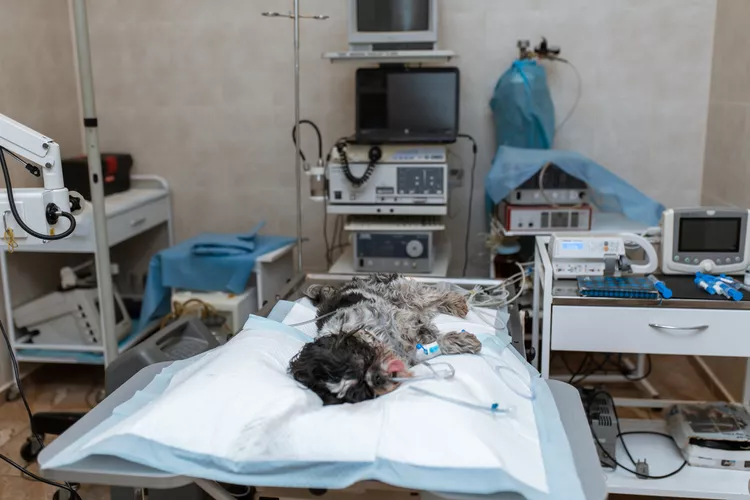
During a dog neuter surgery performed, also known as a canine castration, the dog is kept asleep and pain-free with a well-balanced anesthetic protocol and maintained on gas anesthesia. Many veterinarians also place an intravenous catheter to give IV fluids. Monitoring equipment is used to evaluate a pet’s vital signs during the procedure. It can track heart and respiratory rates, blood pressure, oxygen saturation levels, and electrocardiogram readings of the heart rhythm.
Although a dog neuter is not as invasive as a canine spay, it is a surgery and male dogs should receive ample pain medication before, during, and after the procedure to keep them as comfortable as possible.
Now that you know this male pup will experience minimal discomfort during his procedure, let’s scrub in and get ready to neuter a dog. In this photo gallery, enter a veterinary surgical suite to see a dog neuter surgery performed. There’s no need for you to gown up, throw on a pair of sterile gloves, and add a face mask, though. We’ll keep you away from the sterile field, while still allowing an up-close and personal look during a dog neuter.
- 01 of 08
Shaving and Scrubbing the Surgical Area
Once the dog is under anesthesia and hooked up to the monitoring equipment, surgical prep can begin. For a routine dog neuter, a single incision is made directly in front of the testicles and scrotum. Dogs with undescended testicles, a condition known as cryptorchidism, will experience a slightly different procedure as the undescended testicle may be in the groin or the abdomen, requiring an incision in one of these locations as well.
Rarely, a scrotal ablation may be performed during a dog neuter as well. Instead of removing only the testicles, the veterinarian will also remove the scrotum to prevent it from filling with blood after surgery. This surgery might be performed on larger, older, more active dogs or in dogs with testicular or scrotal diseases that require removal of the scrotum for medical reasons.
To keep things simple, this step-by-step photo gallery is of a routine dog neuter. Both testicles have descended into the scrotum, and the dog is fairly young and small, so a single incision will be all that is necessary. To ensure the surgical field is sterile, all the hair is clipped away from the future incision site. Ideally, a large margin of hair is clipped around the entire incision site to ensure no hair creeps into the surgical field.
After the hair has been clipped and removed, a veterinary technician or assistant will scrub the surgical area with a disinfecting solution. Instead of scrubbing from side to side, the vet tech will scrub in a widening circle pattern, moving outward from the incision site. This prevents hair and dirt from being dragged back into the surgical area and ensures the incision site is as clean as possible.
Continue to 2 of 8 below - 02 of 08
Incising the Skin
Once the surgical area is clipped, cleaned, and draped with sterile drapes, surgery can begin. The single incision is made in the skin, directly in front of the scrotum. Each testicle is pushed up and through the single incision, rather than making two separate incisions for each testicle. Scrotal incisions are avoided because the scrotal tissue is thin, sensitive, and bleeds more than a skin incision, however in very young dogs, this approach is sometimes used as well.
There are two ways to do a dog neuter: open or closed.
In an open castration, the vaginal tunic—the tough membranous covering of the testicle and associated structures—is incised, allowing easy visualization of the spermatic cord. If the vessels are particularly large, an open castration is preferred, since each structure is tied off (ligated) separately to prevent bleeding and slippage of the knots, or ligatures.
In a closed castration, the tunic is not incised, and the spermatic cord and contained structures are ligated all at once, usually with two or three separate knots to prevent bleeding.
This photo gallery demonstrates the closed castration method.
Continue to 3 of 8 below - 03 of 08
Exteriorizing the Testicles
After the skin is incised, the veterinarian gently pushes the testicle up through the incision. In this closed castration method, the veterinarian clamps the entire structure at once—the vas deferens (spermatic cord), pampiniform plexus (vessels around the vas deferens), cremaster muscle, and arterial supply. Clamping all the vessels and structures prevents bleeding and creates a crush mark, or indentation, where the knots will be placed to ensure they don't slip and are as snug as possible.
Continue to 4 of 8 below - 04 of 08
Ligating the Vessels
To prevent bleeding, the veterinarian places multiple knots, or ligatures, around the vessels before removing all of the clamps. A dissolvable suture material is used so that it does not cause irritation to the surrounding tissues over time but instead dissolves as the body heals. There is always a small risk that the knot could slip, causing bleeding. Transfixing ligatures are a special type of knot used to help ensure the knot stays in place and cannot slip so no bleeding occurs. After the vessels are ligated, the testicle is removed and the procedure is repeated on the second testicle.
Continue to 5 of 8 below - 05 of 08
Closing the Incision
Once the vessels are ligated and both testicles are removed, the veterinarian checks for bleeding before closing the incision. If everything looks good, the same dissolvable suture that was used to ligate the testicles can be used to close the incision.
The incision is closed in multiple layers. Internal sutures are placed to close the subcutaneous tissue, then a second layer of sutures brings the skin edges together. Some veterinarians may apply a drop of tissue glue to the incision to cover the final knot under the skin. This closure technique avoids prickly stitches on the outside skin surface, which may prompt dogs to lick and chew. Some veterinarians will use skin sutures if the situation requires it, and these need to be removed in 10 to 14 days.
Continue to 6 of 8 below - 06 of 08
Checking the Surgical Incision
The incision in this small dog is less than one inch long. With such a small incision, there is usually minimal bleeding and swelling. After closing the incision, the veterinarian inspects the site to ensure the skin is closed properly and there is no bleeding.
Continue to 7 of 8 below - 07 of 08
Applying Tissue Glue
A drop of tissue glue may be used at the end of the incision, where the final knot of suture material is buried under the skin.
Continue to 8 of 8 below - 08 of 08
Recovering From Anesthesia
After the incision site is checked and cleaned up, the dog is ready to be recovered from anesthesia. Pets are closely monitored during the recovery phase to ensure a smooth recovery to prevent injury upon waking.
Once the dog returns home, owners have the challenging task of keeping him quiet and calm—and also preventing him from licking or chewing at the incision site. If a dog is too active after surgery, blood vessels in the scrotum ooze and the scrotum can fill with blood, which causes discomfort and may require additional treatments or surgery. Licking and chewing can also be problematic; this behavior can cause infection or open an incision.
Fortunately for this dog, he is young and small, with a tiny incision, so he should heal quickly with no problems. But, if your dog has recently been neutered and has been too active or is licking at his incision, contact your veterinarian for help.